Get and Forward a Phone Number From Your Browser: US and Overseas Numbers
A phone has two halves: calling out, and being reachable. For the second half, you sometimes need a number of your own in another country, a US number or an overseas one, that rings the phone you already carry. Here's what a virtual number is.
 Author
Iqbal Abdullah
A phone does two jobs. It calls out, and it is reachable. I have written plenty about the first job, the part where you dial any number from a browser tab. This post is about the second one.
Sometimes you need a number of your own in a country where you do not live. A US number so that American contacts, services, or a marketplace can reach you on a local one. A number in another country that rings through to the phone you already carry, wherever you happen to be. And you would like to set the whole thing up and manage it from a browser, not a SIM tray and a trip to a phone shop.
That is what a virtual number is for.
What a Virtual Number Actually Is
A virtual number, also called a DID (direct inward dialing), is a real phone number that has no physical SIM or phone line behind it. People dial it like any other number. Instead of ringing a specific handset on a specific carrier, it is programmed to forward incoming calls to a destination you choose: your mobile, a landline, even a number in a different country.
The caller sees and dials your virtual number. The call comes through to whatever phone you pointed it at. The phone that actually rings stays private. To the person calling, it is an ordinary number in their own country. To you, it is just your normal phone ringing.
How Forwarding Works (and Who Pays for It)
Call forwarding is an old, well-understood telephone feature: a call to one number is redirected to another. The detail worth understanding is that a forwarded call is actually two calls bridged together:
- The inbound leg: the caller reaches your virtual number.
- The forwarded leg: the system places an outbound call to your real phone and joins the two together.
It's funny that they call each part of the call "legs". You'll need two legs for the call to stand up!
This has a consequence people miss until they see the bill. You generally pay for the forwarded leg, because that second call is an outbound call to your phone, billed at the normal outbound rate for wherever your phone is. Forwarding a US number to a mobile in Japan costs the inbound portion plus the Japan-mobile outbound rate. None of this is hidden on PuchiDen, and the full breakdown, including the flat inbound rate and the per-country forwarding rates, is laid out in the virtual numbers guide.
What People Use Them For
- Keeping a presence in a country you have left. The classic case is keeping a US number while living abroad so that everyone who has your old number, and every service that insists on a US one, still reaches you.
- A local number for a business. A number with a local area code gives customers in that market a familiar, local way to reach you while your actual operation sits somewhere else entirely.
- Being reachable on your own terms. One number that rings whatever phone you are holding this month, without handing out your real number or swapping SIMs every time you move.
I built PuchiDen's number offering with the e-Residency and nomad crowd particularly in mind, because that is my own situation. If that is you, the companion pieces on the calls you still have to make running a remote company and on getting an Estonian number are worth a read.
The Honest Limits
I would rather you know these before you sign up than discover them after.
There is an identity check. Inbound numbers are regulated. A phone number is treated as a national resource, and the carriers who supply them require that we know who is renting each one. So most countries need a proof of identity, and some need a proof of address or even a local address on file. This cuts against PuchiDen's usual promise of signing up with nothing but an email, and I am not happy about the tension, but there is no version of inbound numbering where the carrier hands over a number blind. We ask for the minimum the destination country requires, and nothing more. The process, including the check, typically takes about a week.
A virtual number is for calls, not for everything. In particular, do not count on it for bank verification codes. Many banks and government identity services will not accept virtual or VoIP numbers for verification at all, because they want a number tied to a physical SIM that proves you hold a specific device. If your only goal is to receive a bank's 2FA text, a virtual number is the wrong tool, and I would rather tell you that than sell you a number that will not do the one thing you wanted.
No emergency calling. A virtual number is for receiving calls. It cannot reach emergency services such as 112, 110, 119, or 911.
Keep your balance topped up. The monthly rental comes out of your prepaid balance. If the balance runs dry, the number is suspended, and a number the carrier has already released may not be recoverable. Auto top-up exists precisely so a number you care about does not lapse by accident.
Will It Receive Text Messages?
This is worth separating out, because people assume a number is a number. Calls and texts are different services that happen to share an address. PuchiDen's virtual numbers are built for receiving calls, which is the job most people actually have. As I said above, SMS to a virtual number is precisely where bank and government verification tends to fail anyway, so if your real goal is one-time codes from your bank, set your expectations low and read the current detail in the virtual numbers guide before you commit to anything. If your goal is "a number people in that country can phone me on, that rings the phone in my pocket," you are squarely in what this is good at.
What It Costs, In Brief
I will not reprint the whole table here, because it lives in the guide and the guide stays current. The shape, though, is three parts. There is a one-time setup fee when your first number is provisioned and verified, which covers the identity check and the carrier provisioning. There is a monthly rental that depends on the country, because a US number is cheaper to hold than, say, a Hong Kong one. And there is the per-minute cost of the forwarded leg, charged only when a call actually rings your phone. All of it comes out of the same prepaid balance you use for calling out, with no separate invoice and no subscription to chase. A call that nobody answers costs you nothing.
The Browser Part
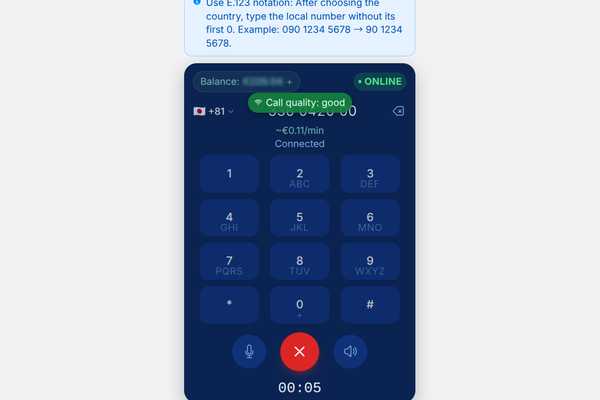
Everything above is managed from a browser. You set which phone the number forwards to, change it when you move, see your call records, and top up your balance, all from the dashboard, with no app to install. Calls forwarded to your phone arrive as ordinary phone calls over the normal network, so they do not depend on you keeping a data connection alive or an app running in the background. We keep inbound call records only briefly, and only for billing, and we never listen to or record the calls themselves. You can read exactly what we do and do not keep.
We offer inbound numbers in a selected and growing list of countries, the United States and the United Kingdom among them, and we add more as we can provision them cleanly. If the country you need is not listed yet, that is often a question of when, not whether.
The way to start is simple. Create an account with just your email, then tell us which country you want a number in. We will walk you through the short identity check and get your number ringing the phone in your pocket. The full country list, the pricing, and the step-by-step are all in the virtual numbers guide.