Virtual Numbers: Supported Countries, Pricing, and How to Get One
Establishing a global presence is simple with Virtual Numbers. Whether you need a local point of contact in the US, UK, or Asia, our service ensures calls reach you without the lag of an app. Discover our supported countries and pricing.
 Author
Iqbal Abdullah
Author
Iqbal Abdullah
A PuchiDen virtual number is a real phone number in another country that people can call. When someone dials it, the call is forwarded over the ordinary phone network to whatever phone you choose (your mobile, a landline, even a number in a different country). The caller only ever sees your virtual number. The phone it actually rings stays private.
There is no app to install and no data connection to keep alive. Forwarded calls arrive as ordinary phone calls, so you skip the dropouts and lag of internet calling. Your number simply rings the phone you already carry. I have spent twenty years building the unglamorous parts of telephony, and this is the part I care about: a virtual number should behave like a phone, not like an app pretending to be one.
This page is the detail behind the virtual numbers overview. Where we currently offer numbers, what each one costs, how call fees work, and the short identity check we run before a number goes live. It is meant to be the page you come back to, so we keep it current.
Where We Offer Numbers
We offer virtual numbers in select countries, not everywhere. Inbound numbers are regulated differently in every country, and we only list a country once we can provision a number there cleanly and keep it stable.
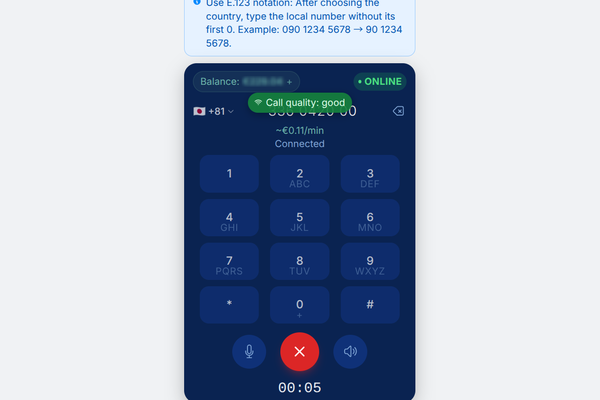
This is different from outbound calling. You can call more than 180 countries from the PuchiDen dialler. Virtual numbers for incoming calls are available in the countries listed below, and we add more over time.
The list below is the authoritative, up-to-date set. If a country you need isn't here, email us. We may be able to source it.
Pricing
The pricing for Virtual Numbers are divided into 3 main parts:
- The one-time setup fee
- The monthly rental fee for a number
- The actual call costs, which consists of the incoming portion (incoming leg) and the outgoing portion (outgoing leg)
Number Rental Pricing by Country
Each number has a monthly rental. The figure below is the starting rental for each country. Some countries offer more than one number type (local, national, and so on), and the exact rental depends on the type you choose, so the table shows the lowest price we offer there. There's also a one-time setup fee and per-minute call fees, both covered in the next section.
The rental is billed automatically from your prepaid balance on the same day each month. There's no minimum term: cancel from your dashboard at any time. Unused days within a paid month are not refunded.
| Country | ISO 3166-1 | Monthly rental |
|---|---|---|
| 🇺🇸 United States | US | from €3.00 |
| 🇨🇦 Canada | CA | from €3.00 |
| 🇬🇧 United Kingdom | GB | from €5.00 |
| 🇪🇪 Estonia | EE | from €6.00 |
| 🇦🇺 Australia | AU | from €15.00 |
| 🇳🇿 New Zealand | NZ | from €8.00 |
| 🇭🇰 Hong Kong | HK | from €20.00 |
| 🇲🇾 Malaysia ※MY | MY | from €8.00 |
| 🇹🇭 Thailand | TH | from €30.00 |
| 🇯🇵 Japan ※JP | JP | from €9.00 |
Rentals are charged in EUR, and that is always the amount debited from your balance. The figure shown is the starting rental for each country. Where a country offers national or other number types, those may be priced higher. Ask us for the exact rental in the country and number type you want.
※MY Malaysian numbers are only available to corporate customers with an address in Malaysia
※JP Japan numbers are only available to corporate customers with an address in Japan
Other Pricing: Setup Fee and Call Fees
A virtual number has three pieces: a one-time setup fee, the monthly rental (above), and per-minute fees on calls that actually connect. You pay all of it from the same prepaid balance you use for outbound calling. There's no separate invoice and no subscription to manage.
One-Time Setup Fee
When your first number is provisioned where we go through the KYC process, there is a one-time setup fee of €20.00. It covers provisioning the number with the local carrier and processing your identity check. It's charged only once per account.
Call Fees
Two phone calls happen each time someone reaches you: the inbound leg (the caller reaching your virtual number) and the forwarded leg (us ringing your real phone). You're billed for both, per minute, and only when the call connects.
| Leg | Rate | Notes |
|---|---|---|
| Inbound (caller → your virtual number) | €0.06 / min | Flat rate, the same for every country. |
| Forwarded (us → your chosen phone) | Standard outbound rate | The same per-minute rate as the PuchiDen dialler, for the country you forward to. See our pricing. |
A few things worth knowing:
- You only pay for connected calls. If a call isn't answered, is busy, or fails, there's no charge for either leg.
- Minimum one minute. Any connected call is billed for at least one full minute, then per minute after that.
- The forwarded-leg rate depends on where you forward to, not where your number is. Forwarding to a mobile costs more than forwarding to a landline, exactly as it does on the dialler.
Worked example. You rent a UK number (from €5.00/month) and forward it to your mobile in Japan. A client in London calls and you talk for 5 minutes:
- Inbound leg: 5 min × €0.06 = €0.30
- Forwarded leg (Japan mobile, €0.26/min): 5 min × €0.26 = €1.30
- Total for the call: €1.60, on top of the monthly rental.
If you'd missed that call, it would have cost you nothing, but remember, if the call was received by your voice mail, then you'll be charged like as usual for the duration of the call.
Keeping your balance topped up matters. The monthly rental is taken from your prepaid balance on your billing day. If your balance is too low to cover it, we will email you and deactivate the number. To bring it back, top up and contact support. A deactivated number may not be recoverable if the carrier has already released it, so we recommend auto top-up.
The Identity Check (KYC)
Inbound numbers are regulated, and the carriers that supply them require us to know who is renting each number. So before a virtual number goes live, we run an identity check (KYC). It's done offline, by our team, and we ask for as little as the destination country requires.
I'll be honest about the tension here. The whole point of PuchiDen is that you can sign up with nothing but an email, no password and no phone number. Asking for an ID document cuts against that. But there is no version of inbound numbering where the carrier hands us a number without knowing who stands behind it. So we ask for the minimum the destination country requires, and nothing we aren't made to.
How to Get a Number
- Register and verify your email. Sign up with just an email address. No password, no phone number, no personal details. Create your account.
- Email us the country you want. Write to [email protected] from your account email address and tell us which country you'd like a number in.
- Complete the identity check. We'll reply with what we need for that country (see below) and review it offline.
- Choose a number. Once you're verified, we'll offer you a few numbers to choose from. This will depend on our stock.
- Your number goes live. Once you've chosen your number, we'll deduct the first month rental and assign the number to your account. The number will appear on your Dashboard and you can now set the phone you want calls forwarded to, and incoming calls start ringing it right away.
Including KYC, the whole process will typically take around 7 business days if we have received everything we need for the KYC.
What We Ask For
Requirements vary by country, because each telecom regulator sets its own rules. Generally, most countries need:
- Business registrar extract A government issued business information extract to prove your business exists at a certain address.
- Proof of identity. A government-issued photo ID.
- Proof of address. For some countries only, a recent document showing your address, such as an utility bill.
- A local address. A few countries require an in-country address on file for the number. We'll tell you up front if the country you've chosen needs one.
We review these documents only to satisfy the carrier's verification requirements. We don't use them to build a profile, and we handle them in line with our privacy policy and EU data-protection law. We don't ask for a phone number to open your account, and renting a virtual number doesn't change that.
In our efforts to make PuchidDen a nomad and remote-worker friendly service, PuchiDen strives to only support numbers from countries that only require a company's business extract, but there are also countries that we support that might require more than that.
KYC Steps
We've compiled detailed information on KYC requirements for countries which are available through PuchiDen:
Privacy and What a Virtual Number Can't Do
Privacy here isn't a setting you switch on. It's how the service is built.
- Your real number stays hidden. Callers see only the virtual number you publish, never the phone the call is forwarded to.
- Records are short-lived. Inbound call records (the caller's number, duration, and cost) are kept for 60 days for billing, then automatically and permanently deleted. We never record, store, or listen to calls.
- EU operator, EU law. PuchiDen is operated by Mirakuru Europa OÜ in Estonia, under GDPR. Cross-border data requests follow formal legal channels (MLAT), not informal ones.
There are limits worth being clear about:
- No emergency calling. This service does not provide access to emergency services (such as 112, 110, 119, or 911). A virtual number is for receiving calls and cannot be used to reach emergency services.
- The phone network is not encrypted end-to-end. Once a call leaves our infrastructure and enters the public phone network, it travels over carrier infrastructure we don't control. No browser-based service can offer end-to-end encryption to ordinary phone numbers. (More on what "encrypted" does and doesn't mean here.)
- Our telecommunications infrastructure provider processes the call metadata needed to route and deliver each call (the calling number, the number dialled, and the timing). That's technically unavoidable.
For the full picture of what we can and can't protect, read the transparency page.
Ready to Get a Number?
Create your account, then email [email protected] from your account address and tell us the country you'd like. We'll handle the rest.
Want the short version first? See the virtual numbers overview.