Press 1 for English: The Hidden Language Your Phone Has Been Speaking Since 1963
Have you ever wondered why you're asked to "press 1 for English" during a call? That simple action relies on DTMF. Read more about this technology dates back to 1963 but still remains the backbone of global IVR systems.
 Author
Iqbal Abdullah
Author
Iqbal Abdullah
You probably have done this hundreds of times. You ring your bank to unblock a card. You ring the airline to change a seat. A recorded voice asks you to "press 1 for English, press 2 for Japanese," and you press a key without thinking about it.
Those beeps are not sound effects. They are how your phone talks to a machine on the other end of the line. The technology behind them is older than the moon landing, runs on essentially every phone network in the world, and probably not many people knows it exists.
It is called DTMF (also known as touch-tone), and the reason it matters today (especially if you are reading this from a café in Lisbon while trying to call a Tokyo bank) is that it is the one piece of 1960s telecom that absolutely has to survive the trip from your laptop's browser to a card-block hotline in Marunouchi. When it does not, you stay locked out. When it does, dinner is saved.
What DTMF Actually Stands For
DTMF is short for Dual-Tone Multi-Frequency. It was invented at Bell Labs in the late 1950s and rolled out commercially by AT&T on November 18, 1963, in Carnegie and Greensburg, Pennsylvania, as a replacement for the rotary dial. (EDN: Touch Tone Phones Are Invented, November 18, 1963)
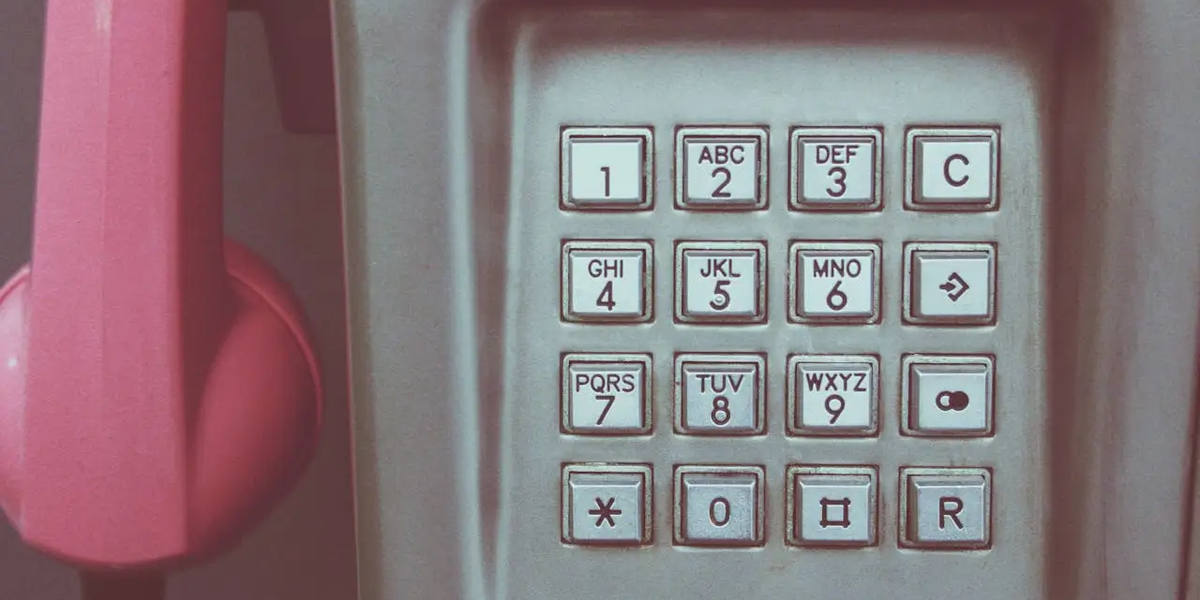
The "dual-tone" part is the clever bit. Every key on the keypad plays two pure tones at the same time, one drawn from a "row" frequency and one from a "column" frequency. Press "1" and your phone emits 697 Hz and 1209 Hz simultaneously. Press "5" and it emits 770 Hz and 1336 Hz. (Wikipedia: DTMF signaling)
Here is the full grid:
| 1209 Hz | 1336 Hz | 1477 Hz | 1633 Hz | |
|---|---|---|---|---|
| 697 Hz | 1 | 2 | 3 | A |
| 770 Hz | 4 | 5 | 6 | B |
| 852 Hz | 7 | 8 | 9 | C |
| 941 Hz | * | 0 | # | D |
The fourth column (A/B/C/D, at 1633 Hz) exists in the standard but never made it onto consumer keypads. It was reserved for military priority dialling and is still occasionally used by amateur radio.
Why two tones and not one? Because a single tone is too easy to fake. A human voice can hum at 697 Hz. A piece of music can pass through 1209 Hz. But two specific tones, at precise frequencies, played simultaneously, basically never happen in nature. The receiving system can be confident that a key was actually pressed and not that a song on hold accidentally rang the doorbell.
The whole thing was standardised by the ITU as Recommendation Q.23 and Q.24, with exact frequencies, ±1.5% tolerance, 50 ms minimum signal duration, and 30 ms minimum gap between tones. (ITU-T Q.24, PDF) Every IVR on Earth implements that spec, which is why your Tokyo bank's automated line can decode tones produced by a phone bought in Manila in 2009.
The Keypad Itself Was Designed By a Psychologist
A small detour, because I find this charming. The reason the keypad is laid out 1-2-3 on top (not 7-8-9 like a calculator) is that an industrial psychologist at Bell Labs named John E. Karlin ran experiments on real users in the 1950s and found that ordering digits top-down produced fewer dialling errors. That same layout is now on every ATM, gas pump, door lock, and hotel safe in the world. A 1955 human-factors study still dictates how you punch in a PIN in 2026. (The Boston Globe)
Why DTMF Beat Rotary, and Then Refused to Die
Karlin designed how the keys were arranged. The keypad itself replaced something older: the rotary dial, a numbered disc you spun with a finger to enter each digit. Dialling a ten-digit number on rotary took about half a minute, watching the disc wind back after each turn. DTMF cut that to a few seconds. That was the immediate win.
The bigger win, the one nobody saw coming in 1963, was that DTMF works during a call, not just to set one up. Once connected, the keypad keeps producing tones the far end can decode. That enabled the entire industry of automated phone systems: voicemail, conference bridges, banking IVRs, airline check-in lines, prescription refills, call centre menu trees. None of that exists in a world where the only signalling you can send is a pulse train at dial-up time.
The numbers are quietly enormous. More than 3.8 billion calls per month go through IVR platforms worldwide, and the global IVR market is on track to clear ten billion US dollars by 2035. (Business Research Insights) Every one of those calls is touching DTMF somewhere.
And the standard has survived every network upgrade since: analog landlines, ISDN, GSM, 3G, 4G, 5G, and modern internet calling. Almost no other 1960s technology is still used daily by billions of people. The spec was simple and physical enough that every later generation just carried it along.
Where You Use DTMF Without Realising It
Once you start looking, it is everywhere:
- Bank phone trees. "Enter your 16-digit card number followed by hash."
- Airline reservations. "Enter your six-character booking reference."
- Conference call bridges. Meeting ID plus PIN.
- Voicemail. Essentially every voicemail system on Earth is navigated by DTMF.
- Two-factor authentication callbacks. Some banks read out a code and ask you to confirm by pressing a digit.
If you have ever pressed a key while on a call, you have used DTMF. You just did not know it had a name.
The Travel Problem: Why Pressing "1" Suddenly Does Nothing Abroad
Here is where it gets interesting, and why I am writing about a 60-year-old signalling standard in 2026.
You are in Bangkok. Your Tokyo bank's automated line answers. It asks for your account number. You press "1" on your roaming SIM, and either nothing happens, or the IVR says "we did not catch that," or the call drops. You try again from the hotel Wi-Fi using whichever calling app you have installed. Same result.
There are three things that can go wrong when DTMF crosses borders, and they are worth knowing in plain English.
1. International roaming sometimes mangles the tones. When your roaming carrier drops you onto an older 2G or 3G fallback, the audio path may get re-encoded in ways that distort the precise frequencies DTMF needs. The tone is technically there, but the receiving IVR cannot tell what key you pressed.
2. Many internet-based calling apps send DTMF "in-band," meaning as audio. That sounds fine until you realise that internet calls almost always compress the audio to save bandwidth. The same compression that turns your voice into a smaller stream also smears the very specific frequencies that make a DTMF tone decodable. Out the other end, your crisp 770 Hz + 1336 Hz "5" arrives as a smudge of noise that the bank's machine politely declines to recognise. (VoIPMechanic, TechTarget)
3. Foreign-number fraud filters trigger a catch-22. When a Japanese bank sees an incoming call from an unfamiliar foreign number, the fraud system often demands extra verification, which is delivered as IVR prompts asking you to press digits. If the digits do not arrive cleanly because of problems 1 and 2, you cannot complete the verification, and the system locks you out. The same defence that protects ordinary customers from scammers locks out the legitimate one trying to reach their own account.
The result, all too often, is a locked card on a Sunday, a missed rebooking after a delay, an unreachable voicemail, and the unique flavour of stress that only happens when you are nine time zones away from the office that could fix it.
How PuchiDen Handles DTMF
PuchiDen was built with this exact problem in mind, because the people building it (myself included) had run into it personally far too many times.
- The tones are delivered reliably to whoever you are calling, whether that is your bank, your airline, a hospital, or a conference bridge. They are carried through our calling infrastructure, not squeezed through whatever audio compression your local hotel Wi-Fi happens to apply.
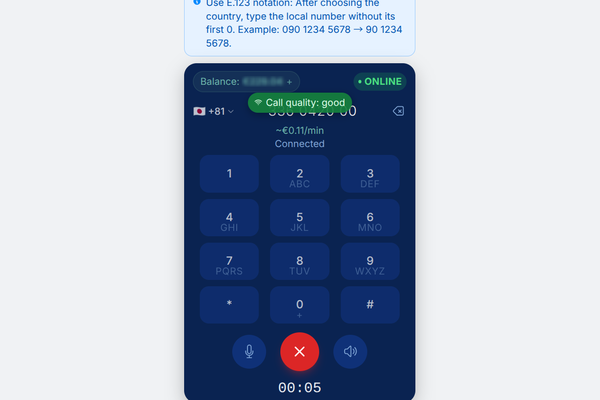
- The keypad inside PuchiDen stays active during a call, not just before it. Tap the keypad icon while connected, press your digits, and the receiving system hears them just as if you were on a traditional landline.
- The connection works the same on a Lisbon café's Wi-Fi, a Manila cellular hotspot, or your home ethernet. No DTMF mode toggle, no codec configuration. It just works.
- Because PuchiDen never records or transcribes your calls, the digits you press (card numbers, PINs, booking references) are not stored, not logged, and not analysed by us. They pass through to the system you dialled and nowhere else. (PuchiDen's Privacy Policy)
That last point matters a lot to me personally. DTMF was literally invented so you would not have to read your PIN out loud to a human operator. A privacy-first calling service that quietly logs every digit you press would defeat the entire point.
Four Real Scenarios PuchiDen Solves
The locked bank card on a Sunday in Madrid. Your Japanese bank's card-block hotline only takes touch-tone input. The roaming SIM dropped twice. You open PuchiDen on the hotel Wi-Fi, dial the hotline, punch in your card number when prompted, the block is lifted, and you go back to dinner. Total elapsed time, under four minutes.
The airline rebooking after a missed connection in Doha. Twenty minutes of hold music, then "enter your six-character booking reference followed by hash." The roaming SIM cut out twice already. Through PuchiDen on the airport Wi-Fi, the digits go through first try and you get on the next flight.
The luggage that was lost was sent to Amsterdam while you were in Jakarta. I heard an anecdote from a friend who had to navigate a complicated phone system to speak with someone at the airline help desk regarding lost luggage from the airport. The lounge Wi-Fi and a quiet meeting room helped to manage stress effectively.
The conference call from a Kyoto ryokan with patchy mobile. The ryokan's mobile signal is weak but the Wi-Fi is fine. You dial the bridge number, enter the nine-digit meeting PIN, and join on time without anyone hearing the cicadas outside.
A Few Practical Tips
Useful regardless of what you are calling from:
- Wait for the prompt to finish before pressing. Many older IVRs ignore tones played over the greeting.
- If the system says "we did not catch that," it is almost always a tone-delivery problem on the other side of the call. Try once more. If you are not already on PuchiDen, this is a reasonable moment to switch.
- Never read your PIN out loud to a voice assistant or to a human agent. DTMF was invented in 1963 specifically so you would not have to.
From 1960s Bell Labs to Your Browser in 2026
DTMF is older than the moon landing, the credit card with a magnetic stripe, and the cassette tape. It is also still running, more or less unchanged, the world's phone menus. That is not because nobody tried to replace it. It is because the spec was good enough, and simple enough, that every new generation of network just learned to carry it faithfully.
The genius of DTMF is that it never needed to be replaced. The genius of doing telecom infrastructure properly in 2026 is making sure it still works perfectly, when you are dialling your bank from a beach.
That is what PuchiDen does. You do not have to think about it. That is the whole point.
Sources
- Wikipedia — DTMF signaling
- Wikipedia — Push-button telephone
- ITU-T Recommendation Q.24 — Multifrequency push-button signal reception (PDF)
- The Boston Globe — John E. Karlin, industrial psychologist for Bell Labs
- History of Information — The Bell System Introduces "Touch-Tone" Dialing
- EDN — Touch Tone Phones Are Invented, November 18, 1963
- TechTarget — What is DTMF and how does it work?
- VoIPMechanic — DTMF issues and problems when using VoIP
- Business Research Insights — Interactive Voice Response (IVR) Market Report